
Faculty AI Partnership Program
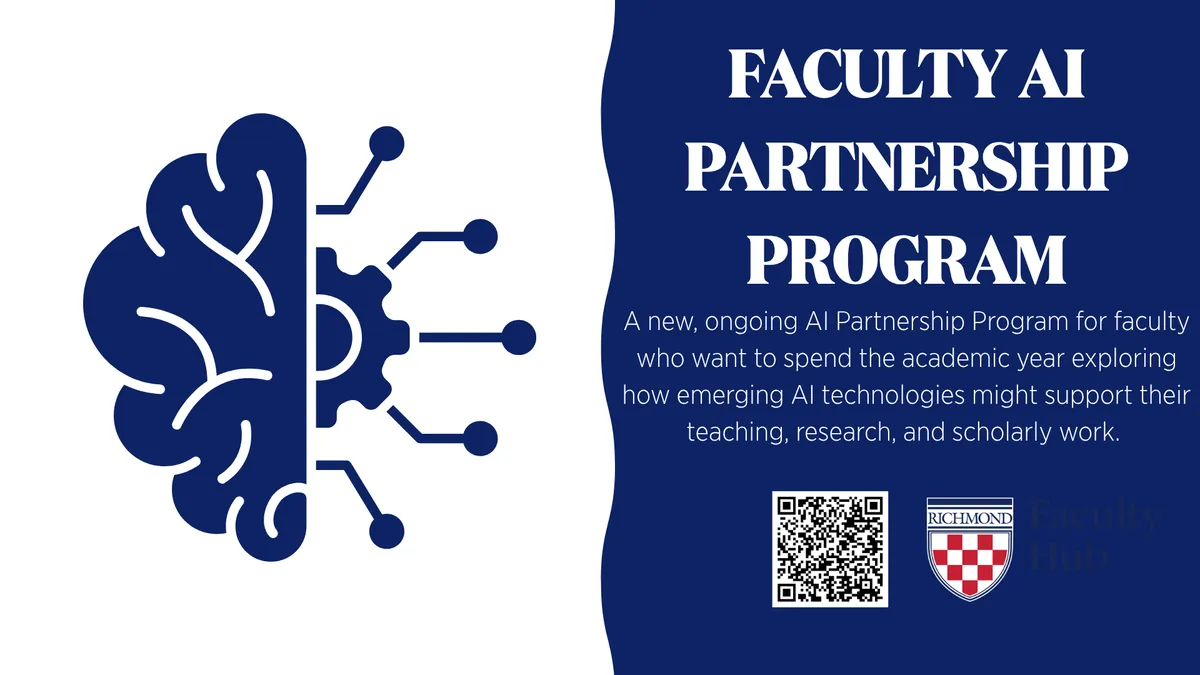
AI Partnership Program
As part of the new Academic + Emerging Technology pilot, the Faculty Hub is launching a new AI Partnership Program for faculty who want to spend the academic year exploring how emerging AI technologies might support their teaching, research, and scholarly work. Because these technologies are changing quickly, the program emphasizes experimentation, reflection, and critical evaluation—learning not only how to use these tools, but also how to question them and determine where they do and do not add value.
Unlike a one-time consultation or workshop, the program is built around an ongoing partnership. Faculty will work alongside Faculty Hub staff to identify a problem or opportunity worth exploring, experiment with new approaches, evaluate what works (and what doesn’t), and refine those approaches over time.
The program is particularly well suited for faculty interested in moving beyond conversational AI and exploring more advanced systems, including agentic tools such as Claude Code, Claude Co-Work, OpenAI Codex, and other emerging technologies. These tools can do more than respond to prompts: they can work across files, analyze information, write and run code, and carry out multi-step tasks with faculty oversight.
Areas of exploration might include:
- AI-assisted research workflows
- Coding and computational research
- Literature review and writing workflows
- Data analysis and visualization
- Workflow automation
- Teaching and course design
- Discipline-specific applications of AI
What the partnership looks like
The partnership begins with a conversation about your work—not with a particular AI tool. We’ll identify a problem, project, or workflow you want to explore and determine whether AI might be useful. If it is, we’ll help you select an appropriate tool, get started, and develop an initial approach.
From there, we’ll meet periodically throughout the academic year to see what is working, troubleshoot what isn’t, and explore new possibilities as they emerge. Some experiments will work well; others won’t. That is part of the process.
By the end of the partnership, our goal is for you to have developed a new capability for your teaching or scholarship toolbox as well as a clearer sense of when AI is useful for your work, when it isn’t, and why.
Experimenting critically
These technologies are changing quickly, and learning how to use them also means learning how to question them. The program therefore emphasizes experimentation, reflection, and critical evaluation rather than adoption for its own sake.
Environmental impact, ethics, privacy, intellectual property, academic integrity, and the implications of delegating intellectual work to AI are all part of the conversation. Participation should not be interpreted as an institutional endorsement of AI or of any particular platform. Instead, the program reflects the Faculty Hub’s commitment to helping faculty examine emerging technologies critically and make informed decisions about whether—and how—they belong in their teaching and scholarly practice.
Because this is a hands-on, collaborative program, participation will be limited each academic year.
Your Partners
Ryan Cales
Ryan’s work with generative AI is grounded in the humanities and his background in rhetoric and composition. Questions of agency, ownership, and originality are central to how he approaches these tools, including in the courses on AI he has taught. He works with faculty to think through where AI might fit within reading, research, and writing practices—and what may be gained or lost when it does.
Andrew Bell
Andrew’s work sits at the intersection of digital pedagogy, research, data, and emerging technology. With a background in systems neuroscience and experience teaching data analysis, data visualization, and computational methods, he approaches AI as another tool whose value depends on the problem, the context, and how intentionally it is used. He works with faculty to experiment with emerging technologies, develop new research and teaching workflows, and determine where AI can meaningfully extend their capabilities—and where existing approaches may still be better.
Presenters
Andrew Bell
Ryan Cales
Contact us
- The Teaching and Scholarship Hub
- fa••••b@ric••••d.edu
Location
Classifications
Categories
- Digital Pedagogy
- Scholarship